

How Acuity AI is used in practice
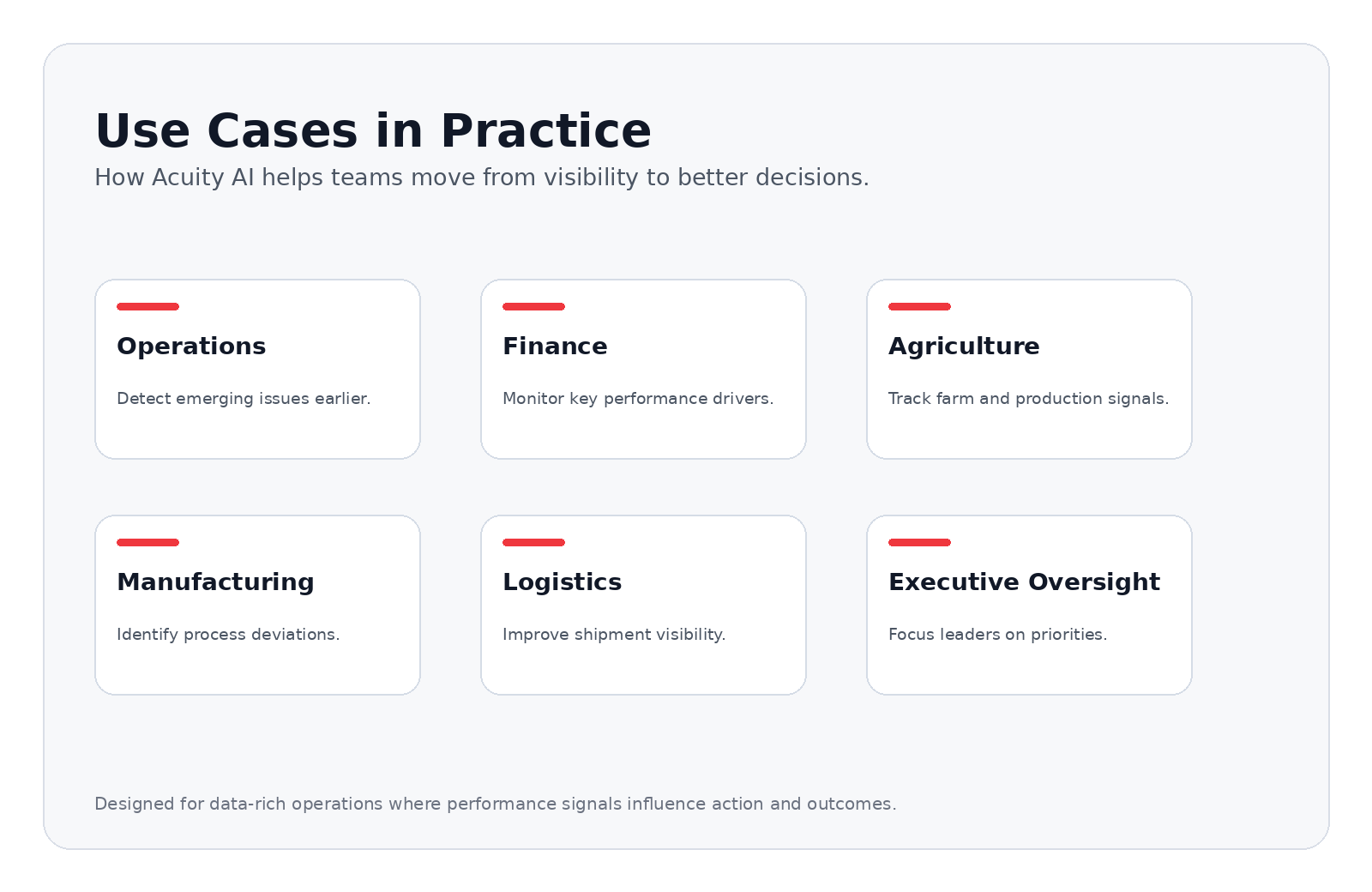
From monitoring performance through responding to issues and making decisions. The use cases on this page describe how teams use Acuity AI day to day.
When performance starts to slip
Performance declines, but it is unclear why or where the issue started.
Detects the change early, explains what is driving it, and highlights where action is required.
The team acts early, with clarity on the items requiring attention.
When there are too many reports, but no clear answer
Teams review multiple reports but still struggle to understand what matters.
Evaluates key drivers, filters out noise, and prioritizes what requires attention.
Decisions follow from the items that carry weight, filtered from the rest of the data.
When deciding what to do next
The team has identified an issue but the right response is unclear.
Recommends actions based on patterns, context, and performance impact.
The team moves from insight to action faster, with a structured rationale.
When teams need to follow through
The team has identified the required actions but execution is slow or inconsistent.
Supports execution with draft outputs, communications, and guided next steps.
The team carries decisions through to execution.
When performance needs to be understood across the business
Different teams or units perform differently, but comparisons are difficult.
Standardizes evaluation and compares performance across units, time, and targets.
The team works from a consistent view of performance across units, time, and targets.
A single decision system for day-to-day management and broader business decisions
Acuity AI combines these capabilities in one system. Teams detect change, prioritize the items requiring attention, respond, and execute within a single tool.